
Consider a quadratic objective observed at a fixed radius. We get the order of the values, not the values themselves. Comparing a point with its opposite cancels the quadratic term. Comparing points on different lines gives more information, but also brings unknown curvature back into the problem. Our question was whether a better choice of measurement locations could make that curvature manageable.
Restrict the measurements, not the Hessian🔗
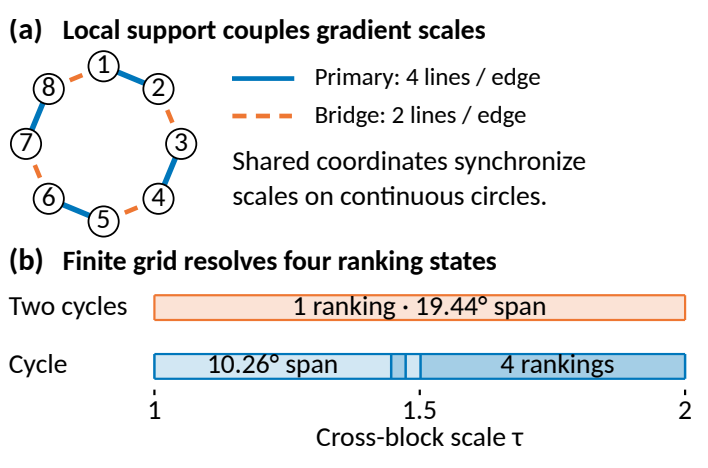
On a circle in the plane of coordinates i and j, only two diagonal Hessian entries and one cross term affect the quadratic part. The other entries need not be small; the measurement simply does not see them. Link such planes in a cycle and adjacent planes share a coordinate. On the continuous circles, if every gradient coordinate is nonzero, that common coordinate ties the relative scales together. With disconnected components, distinct gradient directions can preserve exactly the same order.
For even dimensions d ≥ 8, the discrete design uses 6d endpoints in one batch. After removing a constant invisible to rankings, the measurements have an exact representation with 3d − 1 coefficients, including the linear part. This is a statement about what the measurements can represent. It does not mean that one finite ranking identifies a direction exactly.
Separate what the decoder buys from what the design buys🔗
On 768 quadratic targets at three radii, rank weighting gave 10.04° angular RMSE on the cycle queries. Fitting a quadratic consistent with the very same order reduced that to 0.97°. That comparison changes the decoder, not the measurement locations.
To test the design, we instead fixed the quadratic decoder and the evaluation budget. Against mirrored orthogonal frames, the cycle reduced mean squared angular error by 19.0% on 128 fresh, condition-matched targets; the adjusted interval was 1.44% to 32.22%. This does not isolate connectivity as the cause. In particular, the controls did not establish that connectivity or phase alone reliably improves finite-budget accuracy. A proof of identifiability and evidence of lower finite-sample error answer different questions.
Source: “Structured Queries for Ordinal Gradient Recovery Under Unknown Curvature,” Figure 1, Table I, and Section V. Joint work by Zhuangzhuang Pan and Kaiwen Lei, with equal contribution. Project code · Project experience
考虑一个在固定半径上观测的二次目标。我们得到的是函数值的排序,而不是数值本身。将一个点与其对向点比较可以消去二次项;跨直线比较提供更多信息,却也将未知曲率带回问题。我们关注的是:能否通过更好的测量位置,让曲率更容易处理?
限制测量,而不是限制 Hessian
在坐标 i 与 j 所张平面的圆上,仅两个 Hessian 对角项和一个交叉项会影响二次部分。其他项不必很小,只是测量看不到它们。将这些坐标平面连成一个环,相邻平面便共享一个坐标。在连续圆上,若每个梯度坐标均非零,共享坐标就能将相对尺度连接起来。而不连通的分量可能让不同梯度方向保留完全相同的排序。
对于偶数维度 d ≥ 8,离散设计在同一批次使用 6d 个端点。去掉对排序不可见的常数后,测量可用包含线性部分在内的 3d − 1 个系数精确表示。这说明测量可以表示什么,不代表一次有限排序就能精确识别方向。
区分解码器收益与查询设计收益
在三个半径、768 个二次目标上,对环形查询进行排序加权得到 10.04° 的角度 RMSE。对同一排序拟合一致的二次模型后,RMSE 降至 0.97°。这个比较改变的是解码器,而不是查询位置。
要检验设计本身,我们固定二次解码器和评估预算。相较镜像正交框架,环形设计在 128 个新的、条件匹配的目标上将平均平方角误差降低 19.0%,调整后区间为 1.44% 至 32.22%。这并未隔离连通性作为原因;对照也没有证明仅靠连通性或相位就能稳定改善有限预算精度。可识别性证明和有限样本误差下降,回答的是不同问题。
来源:“Structured Queries for Ordinal Gradient Recovery Under Unknown Curvature”,图 1、表 I 和第 V 节。Zhuangzhuang Pan 与 Kaiwen Lei 合作,同等贡献。 项目代码 · 项目经历