
Suppose two forecasts each have variance one. If their errors are uncorrelated, the variance of their difference is two. If their errors have correlation 0.9, it is only 0.2. Neither individual forecast has changed. For someone asking how much a signal will rise or fall, those are two very different predictions.
Change the dependence, keep the forecasts🔗
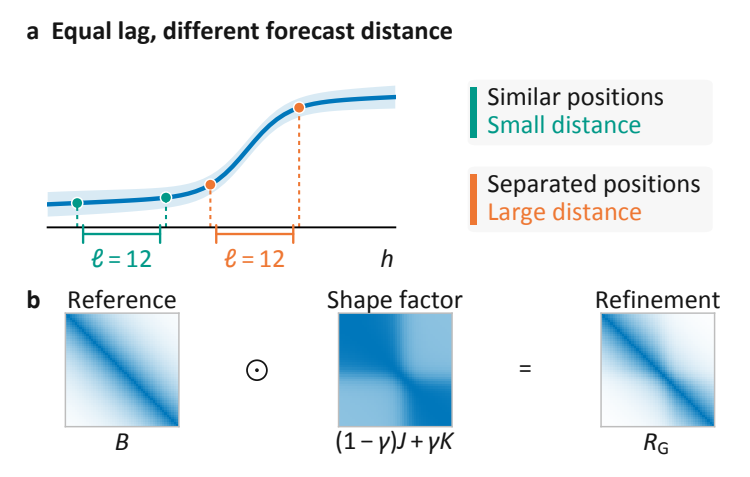
In our study, Chronos-Bolt Small and FlowState r1.1 supplied cached quantiles at 48 horizons. Each horizon got four coordinates: spread, median relative to the forecast as a whole, change from the preceding median, and outer width relative to inner width. Two points twelve steps apart can be close in these coordinates on a plateau and far apart across a ramp.
We turned coordinate distances into a positive semidefinite similarity matrix and multiplied a temporal correlation matrix by a mixture of that similarity and an all-ones matrix, entry by entry. The result is still a valid correlation matrix with ones on the diagonal. In a Gaussian copula this lets us change how the horizons move together while keeping each marginal forecast fixed.
Does the shape have to be in the right place?🔗
A fair control needs the same fitting flexibility. Across six datasets and both backbones, the shape-aware model reduced normalized change CRPS (a distributional error score; lower is better) by 0.2005% against a parameter-matched time-only kernel. We also rotated the shape features along the horizon axis and refitted the model for every nonzero shift. The true alignment ranked first out of 48. The effect was small, but adding parameters alone does not explain that ordering.
The more useful result is where the correction mattered. For horizon pairs far apart in shape, the 90% interval score fell by 3.59% and empirical coverage rose from 82.70% to 85.68%. These groups were defined within each lag, so the comparison is not just short versus long forecasts. Coverage still missed 90%, and low-distance pairs showed little benefit. I would check those conditional results before treating the aggregate gain as a reason to deploy.
Source: “Forecast-Geometry-Guided Dependence Calibration for Time-Series Changes,” Figure 1 and Tables I–III. Kaiwen Lei and Zhuangzhuang Pan contributed equally, with Bohan Guo and Yan Xia. Project code · Project experience
设两个预测的方差均为 1。若误差互不相关,差值的方差为 2;若误差相关系数为 0.9,差值方差则只有 0.2。两端各自的预测都没有变化,但对关心信号将上升或下降多少的人而言,这是截然不同的判断。
调整依赖关系,保留原始预测
在这项研究中,Chronos-Bolt Small 与 FlowState r1.1 提供了 48 个预测时域的缓存分位数。每个时域有四个坐标:离散程度、中位数相对整条预测的水平、与前一中位数的变化,以及外层宽度相对内层宽度的比例。相隔 12 步的两个点,在平台段可能很接近,在上升段却可能相距很远。
我们将坐标距离转为半正定相似度矩阵,再将时间相关矩阵与“相似度矩阵和全 1 矩阵的混合”逐元素相乘。结果仍是对角线为 1 的有效相关矩阵。在 Gaussian copula 中,这允许改变不同预测时域如何共同变化,同时保持每个边缘预测不变。
形状信息是否必须出现在正确位置?
公平对照需要相同的拟合灵活度。在六个数据集和两个骨干预测器上,形状感知模型相较参数量匹配的纯时间核,将归一化变化 CRPS(越低越好的分布误差评分)降低 0.2005%。我们还沿时域轴循环移动形状特征,并对每个非零位移重新拟合。真实对齐在 48 种情况中排名第一。效应虽小,但仅用参数增多无法解释这个排序。
更有价值的是校正发生在哪里。对形状距离较大的时域对,90% 区间评分降低 3.59%,经验覆盖率由 82.70% 提升至 85.68%。分组在每个时间滞后内部定义,因此不只是短期与长期预测的比较。覆盖率仍未达到 90%,低距离组收益也很有限。我会先检查这些条件性结果,再判断汇总增益是否足以支持部署。
来源:“Forecast-Geometry-Guided Dependence Calibration for Time-Series Changes”,图 1、表 I–III。Kaiwen Lei 与 Zhuangzhuang Pan 为同等贡献,合作作者还包括 Bohan Guo 和 Yan Xia。 项目代码 · 项目经历