
An evaluation and a round of feedback are different resources. A lab may be able to run fifty settings together but have to wait until tomorrow to choose the next fifty. In that setting, keeping only the winner of each opposite-point comparison throws away some information already paid for.
A cancellation you can read off the order🔗
Write the local objective as a linear signal plus an even term: opposite points have opposite linear contributions but the same nuisance offset. Suppose the ranking puts xⱼ above xᵢ and −xᵢ above −xⱼ. Add the two inequalities. Each nuisance offset appears on both sides, leaving a comparison between the two linear projections. No numerical objective values or Hessian estimate are needed.
This separates three kinds of information. Mirror keeps only the signs within opposite pairs. Reverse also keeps short cycles such as the one above. Full keeps every direction for which some choice of nuisance offsets explains the entire order. Its feasible set can be strictly smaller. But ruling out a direction need not improve the next optimization step.
The resource constraint changes the result🔗
When the even term varies sufficiently little across the query sphere relative to the linear signal, short cycles can localize the direction in one round at near-optimal evaluation cost. Without a common bound on relative curvature, the worst-case cost for angular error ε is Θ(d/ε) in one round and Θ(d log(1/ε)) given enough adaptive rounds. Evenness makes cancellation valid; it does not, by itself, guarantee a useful one-round estimate.
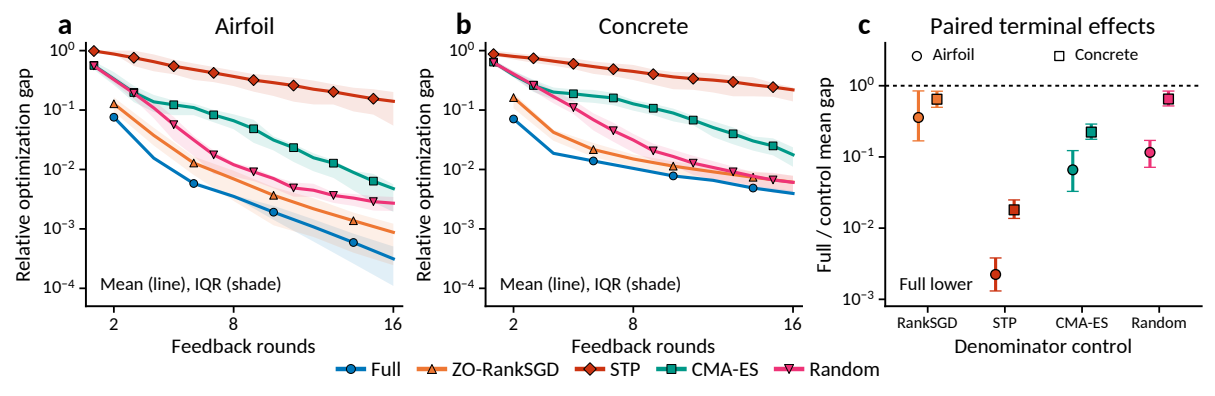
On two ridge-regression tasks with at most 16 feedback rounds, the independently tuned short-cycle method left 0.374 times the mean relative training gap of ZO-RankSGD on Airfoil and 0.645 times on Concrete. Fitting longer cycles did not yield an established additional optimization gain. And when the round cap was removed, sequential three-point search and CMA-ES finished with smaller mean gaps than the full-ranking method on both tasks. The practical argument here is for spending a scarce round well, not for ranking-based updates in every setting.
Source: “When Do Rankings Beat Signs? Gradient Direction Recovery under Even Nuisance,” Figure 4 and Tables 1–3. Results concern optimization of the training objective, not a comparable improvement in test prediction. Project experience
一次评估和一轮反馈是不同资源。实验室也许能同时运行 50 种设置,却要等到明天才能决定下一批 50 种设置。在这种情况下,只保留每对对向点比较的胜者,就丢掉了已经付出成本的信息。
从排序中直接读出的抵消关系
将局部目标写为线性信号与偶对称项之和:对向点的线性贡献相反,却共享相同的干扰偏移。若排序中 xⱼ 高于 xᵢ,而 −xᵢ 又高于 −xⱼ,将两个不等式相加后,各干扰偏移分别出现在两侧,留下两条线性投影间的比较。不需要数值目标值,也不需要估计 Hessian。
这区分了三种信息。Mirror 只保留对向点对内的符号;Reverse 还保留上面这样的短环;Full 保留所有能由某组干扰偏移解释完整排序的方向,其可行集可能严格更小。但排除某个方向,并不必然改善下一步优化。
资源约束改变结论
当查询球面上的偶对称项相对线性信号变化足够小时,短环可用近最优评估成本在单轮中定位方向。若没有统一的相对曲率界,为达到角误差 ε,最坏情形成本在单轮中为 Θ(d/ε),在允许足够自适应轮数时为 Θ(d log(1/ε))。偶对称性保证抵消有效,却不单独保证单轮估计足够有用。
在最多 16 轮反馈的两个岭回归任务中,独立调参的短环方法留下的平均相对训练差距,分别为 ZO-RankSGD 在 Airfoil 上的 0.374 倍和 Concrete 上的 0.645 倍。尚未证实拟合更长环能增加优化收益。取消轮数上限后,顺序三点搜索与 CMA-ES 在两个任务上均取得比完整排序方法更低的平均差距。这里的实践论点是用好稀缺的一轮反馈,而不是在所有设置中都采用排序更新。
来源:“When Do Rankings Beat Signs? Gradient Direction Recovery under Even Nuisance”,图 4、表 1–3。结果涉及训练目标的优化,不代表测试预测同幅度提升。 项目经历