
One answer to a travel question offers two routes and compares costs. Another gives a single concise recommendation. A rubric that rewards both completeness and brevity can score each answer precisely without saying which should win. Picking the answer that passes more criteria sounds reasonable, but it introduces a voting rule. If the rubric did not authorize one, a confident verdict hides a choice about values.
Test the rule without asking the model to score prose🔗
TradeoffBench supplies exact pass/fail vectors on five criteria. A response wins under strict Pareto dominance only when it is no worse on every criterion and better on at least one. Identical vectors call for equality. If each response wins somewhere, the correct output under this rubric is to defer, not to call it a tie.
Six non-reasoning judge configurations passed every dominance and equality control. Yet they chose unsupported winners on 8.85% to 81.12% of 1,345 conflicts in the vector/disjoint condition. In a separate audit, three reasoning-enabled configurations returned only 2 unsupported winners in 9,720 conflict judgments. These are distinct audits, not a paired estimate of the effect of reasoning. Deferral shows the model executed the rule; it does not tell us what the intended reader prefers.
Whose scores enter the decision?🔗
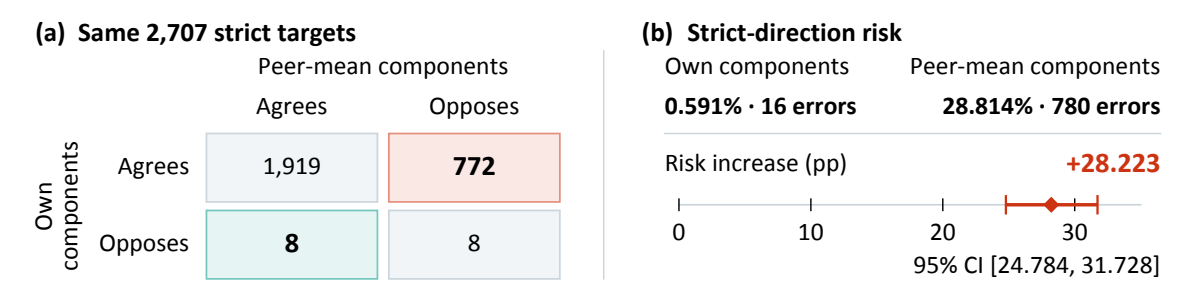
The human-data experiments ask a different question and use no LLM judge. On 2,707 MultiPref comparisons with a strict target preference and a decision under both score sources, the same Pareto rule disagreed with the intended rater 16 times using the rater's own component scores and 780 times using peer means. Changing the score source alone took disagreement from 0.6% to 28.8%. This rate pertains to those jointly decided cases, not all MultiPref records.
In HUMAINE, declaring partial trade-offs made another 2.5 percentage points of comparisons decidable. Among strict rater preferences, disagreement was 3.9% on the newly decided cases versus 0.9% on Pareto decisions. A useful evaluation report therefore needs three separate entries: what the original rubric decides, which extra premise resolves the remaining cases, and how often those additional decisions disagree with the intended rater.
Source: “When Rubrics Do Not Decide: Silent Value Completion in LLM Evaluation,” Sections 3–5, Figure 3, and Table 14. Project experience
一个旅行建议给出两条路线并比较成本,另一个只给出一条简洁推荐。若评分准则同时奖励完整性和简洁性,它可以精确评价每份回答,却未必规定哪份应该获胜。选择“满足更多准则”的回答听起来合理,但这实际上引入了投票规则。若原准则没有授权该规则,一个自信的裁决便掩盖了一次价值选择。
不让模型给文章打分,直接检验规则执行
TradeoffBench 在五个准则上提供精确的通过/不通过向量。严格 Pareto 支配要求:一个回答在每项准则上都不差,并至少在一项上更好,才可获胜。完全相同的向量应判为相等;若双方各有优势,正确输出应是暂缓裁决,而不是平局。
六种非推理评判配置通过了全部支配和相等对照,却在向量/不重叠条件的 1,345 个冲突中,选出了 8.85% 至 81.12% 的无依据胜者。另一项审计里,三种开启推理的配置在 9,720 次冲突判断中仅给出 2 次无依据胜者。这两项是不同审计,不能当成推理效果的配对估计。暂缓裁决说明模型执行了规则,却没有说明目标读者真正偏好什么。
谁的分数进入决策?
人类数据实验问的是另一件事,且不使用 LLM 评判者。在 2,707 个 MultiPref 比较中,目标评分者具有严格偏好,两种评分来源也都能作出决策。使用目标评分者本人的分项分数时,同一 Pareto 规则与其偏好不一致 16 次;改用同伴平均分时,不一致 780 次。仅改变评分来源,分歧率就由 0.6% 升至 28.8%。这个比率只适用于双方均能决策的子集,而不是所有 MultiPref 记录。
在 HUMAINE 中,声明部分权衡关系,使额外 2.5 个百分点的比较可被裁决。在具有严格评分者偏好的案例中,新获裁决案例的分歧率为 3.9%,Pareto 决策则为 0.9%。因此,有用的评估报告应分别交代:原准则能裁决什么、哪个额外前提解决了其余案例,以及这些新增决策有多常与目标评分者不一致。
来源:“When Rubrics Do Not Decide: Silent Value Completion in LLM Evaluation”,第 3–5 节、图 3 和表 14。 项目经历